When Does Your Product Become a Medical Device?
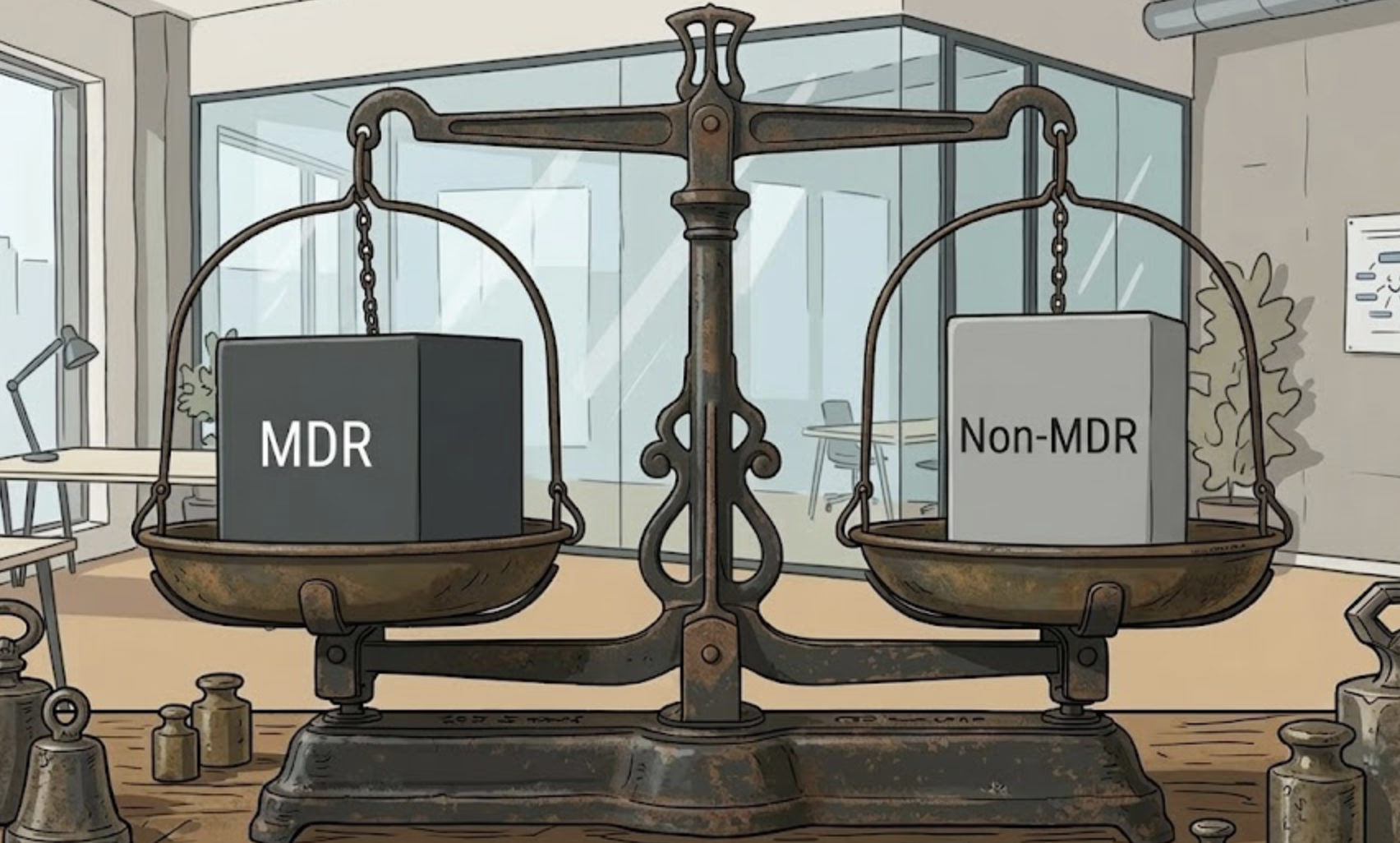
One sentence on your website can turn your wellness app into a regulated medical device. Not the code. Not the algorithm. The sentence that describes what the product does.
Founders pick their framing early. You write the app-store copy. You brief the marketing team. You pitch investors. Each decision looks fine on its own. Together, they build a regulatory story you did not mean to tell, and that story cannot be fixed with money or momentum.
A quick explanation of what we are talking about
Under EU MDR, "intended purpose" is not what you believe your product does. It is what you say it does, publicly, anywhere. Your website, your IFU, your pitch deck, your app-store description. If any of those materials describe diagnosing, monitoring, predicting, or treating a disease or injury, regulators treat your product as a medical device. The wording is the classification.
The 3 risks that will not wait
Accidental classification. You chose "wellness" because it felt safer and moved faster. But if your product screens for a condition, predicts disease risk, or recommends a clinical action, Rule 11 under MDR Annex VIII likely puts you in Class IIa or higher. The worst case: you build your product and your business on a classification that regulators reject.
Frozen marketing. Every public claim is regulatory evidence. A line about "detecting early signs of depression" or "screening for atrial fibrillation" reframes your product permanently. You cannot quietly walk it back. The worst case: your product is pulled from the market while you rework your documentation.
Mid-development rework. Intended purpose drives your clinical evaluation, risk management, and technical file. Change it halfway through and you are not editing a document, you are restarting core work. The worst case: a 12-month delay arriving just before a funding milestone.
What starting early actually means
- Write your intended purpose as a single sentence before you write any public-facing copy. Name what the product does, who uses it, and what health outcome it touches, if any. This sentence is the foundation everything else builds on.
- Test your claims against the MDR borderline rules before your marketing team touches them. The distance between "tracks your mood" and "detects signs of depression" is a few words wide and a regulatory world apart.
- Map your software functions against Rule 11 now, not at launch. Diagnostic suggestions, treatment recommendations, and risk predictions each carry classification consequences. Know where you stand before you are in a room with a Notified Body.
Before the claims become the record
The gap is rarely technical. It is one honest conversation about intended purpose that founders keep deferring because the product is not finished yet. By the time it is finished, the words are already out there.
If you are not certain where your claims land, the free 20-minute MDR assessment at healthtechpathways.org gives you a clear read before your wording becomes your regulatory record.